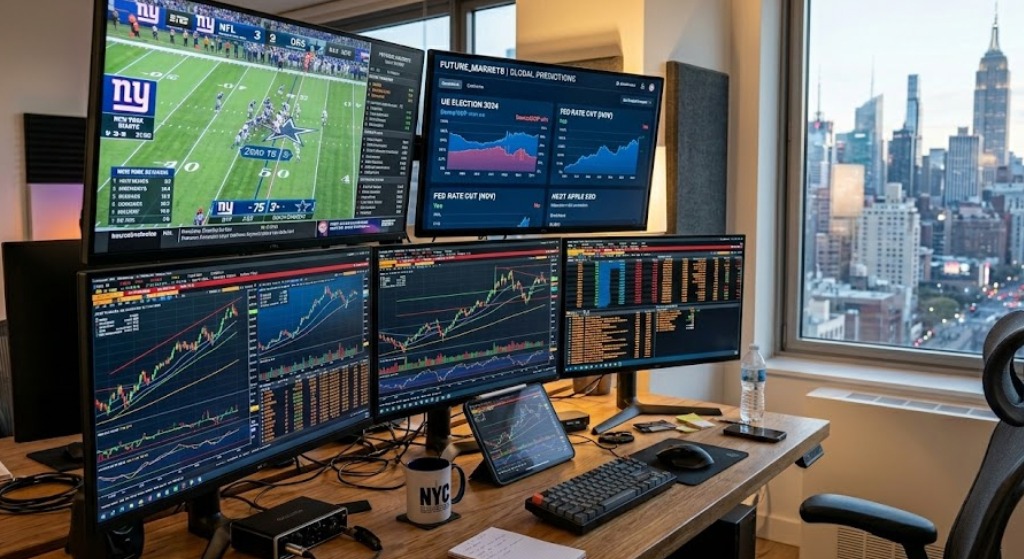
Not even a decade ago, prediction markets were a small niche interest used as forecasting tools by polling experts. Today, they are a multibillion dollar business sector that everyone is talking about. And, despite not being considered gambling under federal law, their massive revenues are increasingly driven by sports contracts. That, has got regulators in some 20 states challenging the model.
So what’s the outlook on the newest, biggest game in the US? And how could the future of the market play out?
How Much of the Boom is Sports Trading, Actually?
Originally, prediction markets didn’t offer sports at all. They almost exclusively focused on political and global events. However, today sports betting is their primary revenue driver. Even the big sports betting giants like FanDuel and DraftKings are getting in the game, launching their own prediction apps in recent months.
In 2025, prediction markets saw total volume of trading hit an estimated $50 billion. During big events, Kalshi and Polymarket have both reported over $1 billion in trading in a week.
Despite being regulated by Commodities Futures Trading Commission as a financial instrument, up to 80% of contract trading on Kalshi is on sports markets as of 2026. You only have to open up Kalshi’s homepage to see it is full list of sports contracts.
Polymarket is a little less sports reliant, but it still has around 50% to 60% of contracts as sports. Nevertheless, both have also reported $1 billion in trading on big ticket sporting event contracts several times. That included record trading levels in and around the 2025 Super Bowl for example. Although they did not beat that in 2026.
Why Sports is a Perfect Fit for Prediction Markets
Sports are ideal for prediction markets to chase. Sports fans already know about betting style engagement and marketing, and they’re interested in narratives and predictability.
From a customer standpoint, prediction markets beat sportsbooks because:
- It feels like a financial market, competing against others not the house
- Expanded markets such as ads, speeches, random events during the game
- Simple binary outcomes in most cases
Given all that, it’s no surprise that sportsbooks and other gambling operators are now launching their own prediction markets.
Now that there’s more competition on the scene, prediction market traders are starting to shop around for the best service. Traders might look for a polymarket promo code from a comparison site, which collects all the options in one place in aid of an informed decision. Not only on sign up offers, but other factors like payment speeds and depth of contract markets.
All of this interest added up to things like a Kalshi advert proclaiming “Bet on the NFL, Legal in 50 states”. Which it has since somewhat backtracked on. But the point remains. They claim not to be betting, but they certainly know which kind of gamers they’re marketing to.
Massive Marketing Spend and Regulator Pushback
Once prediction markets secured CFTC regulation and rolled out nationally, they soon realised how popular they would be. Markets on the 2024 Presidential election boosted Kalshi and Polymarket into the media spotlight considerably. Sports then soon followed, and now the revenue numbers speak for themselves.
This influx of money allowed the big players to spend big on integrating themselves within the sports world. Kalshi even recently offered a $1 billion prize for a perfect March Madness bracket pick. Prediction markets have positioned themselves in the sports media space as key providers of supposedly accurate predictions about sporting events.
The validity of these claims to truth after certainly still under question. Some studies have shown them to better at predicting global events than most experts, while others have shown them only being marginally better than a 50/50 random guess.
What’s also under question is the legality of the whole model, and whether or not it really is just gambling. Now that these operators are so visible, state gambling regulators have been increasingly acting to try and curb them.
Federal vs State Conflict is the Heart of the Issue
The federal government says Polymarket is not sports betting. States, who under law are allowed to regulate their own gambling laws, say it isn’t.
There are dozens of currently pending cases, attacking prediction markets as a model and from various other angles. Some only go after sports, others claim they are completely gambling. Others talk about the potential for insider trading, and rigged markets.
While sports betting is a big part of the issue for many, some regulators and politicians simply don’t like that anything they consider gambling is offered in their state without their approval and involvement in how it is run.
On the pro prediction market side – millions of traders, and lots of money. CFTC chair Michael S. Selig has been bullish on prediction markets, and has promised to fight states in court over the issue. There is an increasing likelihood of Supreme Court involvement some time in 2026. Which, funnily enough, you can bet on – sorry, trade contracts on – at Kalshi and Polymarket.
If it does go all the way to the top court, expect it to be one of the most watched court cases of the year. The sector may also have the Trump administration on side, as Trump Jr. is a key advisor at both Kalshi and Polymarket..