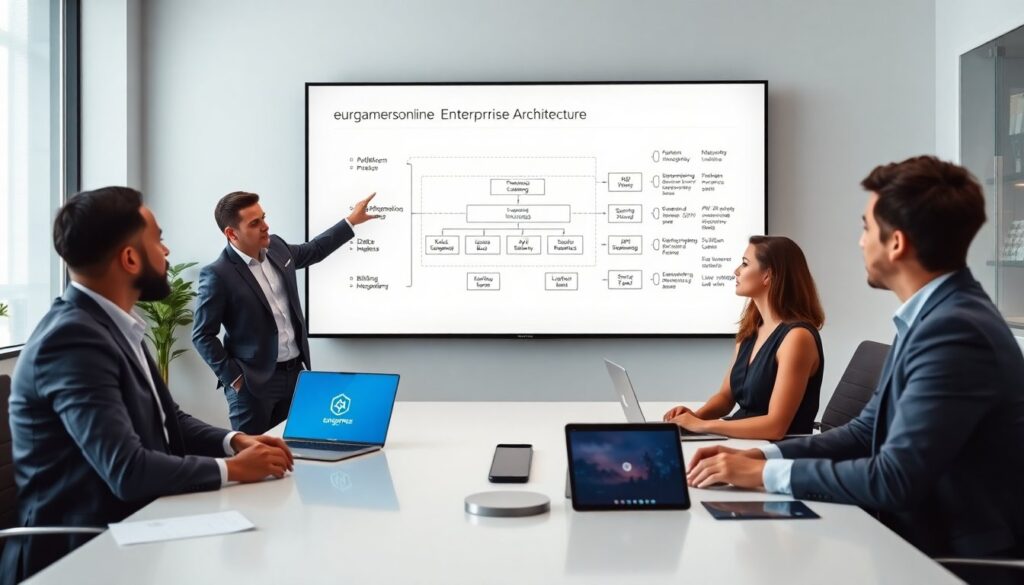
Eurogamersonline 2d art distinct visual knack must align business goals and platform needs. This blueprint gives focused goals, core layers, a clear stack, and a phased roadmap. It shows how eurogamersonline enterprise architecture supports growth, reliability, and faster feature delivery. Readers will find actionable design choices and a migration plan they can carry out in 2026.
Key Takeaways
- The EuroGamersonline enterprise architecture aligns business goals with platform needs to support growth, reliability, and faster feature delivery.
- Core architecture layers—platform, application, data, and integration—are clearly separated to simplify scaling and maintenance.
- The recommended tech stack uses Kubernetes, serverless, cloud event buses, and OAuth2 to accelerate iteration and keep operations manageable.
- A phased implementation roadmap with quick wins and gradual migration ensures a safe transition from legacy systems.
- The architecture targets 99.95% uptime, five-second matchmaking, and compliance with GDPR and regional tax laws.
- Focusing on modular services and event-driven designs helps EuroGamersonline reduce downtime and improve player experience.
Why Enterprise Architecture Matters For EuroGamersOnline Now
EuroGamersonline enterprise architecture guides scaling and risk control. The esports market draws larger audiences and tighter schedules, and the platform must handle peak events. EuroGamersonline enterprise architecture reduces downtime, improves player matchmaking, and speeds feature rollout. Industry coverage documents the rise of esports and its cultural impact, which explains why platforms must plan capacity and product roadmaps with intent. The architecture also supports monetization and compliance while keeping operational costs predictable.
Business Capabilities, Users, And Domain Model
EuroGamersonline enterprise architecture maps core capabilities to users. Core capabilities include event orchestration, tournament management, player profiles, matchmaking, streaming ingestion, and billing. Primary users include players, organizers, broadcast teams, and advertisers. The domain model separates user identity, game sessions, event catalog, telemetry, and payments. Each domain stores its own data and exposes APIs. This domain model lets the eurogamersonline enterprise architecture limit blast radius and scale only needed components.
Target Architecture Vision: Goals, Principles, And Nonfunctional Requirements
The target vision makes eurogamersonline enterprise architecture resilient and fast. Goals include 99.95% uptime during events, five-second matchmaking median, and five-minute deploys for nonbreaking changes. Principles favor modular services, event-driven telemetry, and API-first contracts. Nonfunctional requirements cover latency, throughput, security, and observability. The architecture must support GDPR and regional tax rules. The vision sets measurable targets and clear ownership for each service and data store.
Core Architectural Layers And Their Responsibilities
EuroGamersonline enterprise architecture divides responsibilities into clear layers. Each layer serves a single set of concerns and exposes stable interfaces. This separation simplifies upgrades and scaling. Teams align to a layer to reduce cross-team coupling and to speed delivery.
Core Architectural Layers Explained (Platform, Application, Data, Integration)
Platform layer provides compute, container orchestration, and CDN. Platform enables autoscaling and policy enforcement. Application layer hosts microservices for matchmaking, events, and billing. Application services expose HTTP and messaging APIs. Data layer stores transactional data, time-series telemetry, and long-term archives. Data services use partitioning and read replicas. Integration layer handles event buses, API gateways, and third-party connectors. Integration routes streaming data to analytics and to broadcasters. Together these layers keep eurogamersonline enterprise architecture maintainable and observable.
Recommended Technology Stack And Integration Patterns
The stack combines managed services and open components to reduce ops load. For compute, use Kubernetes for services and serverless for event handlers. For messaging, use a cloud event bus and Kafka for high-throughput telemetry. For storage, use a relational database for transactions and a columnar store for analytics. For identity, adopt OAuth2 and a dedicated identity service. Use API gateway and service mesh for traffic control. Integration patterns include event sourcing for game state, CQRS for read models, and saga patterns for cross-service transactions. This stack supports fast iteration while keeping eurogamersonline enterprise architecture predictable.
Implementation Roadmap: Phases, Quick Wins, And Migration Strategy
Phase 1 focuses on quick wins and safety. Quick wins include central logging, a single API gateway, and a staging Kubernetes cluster. Phase 2 modularizes legacy monoliths into services for matchmaking and billing. Phase 3 moves telemetry to a streaming platform and deploys autoscaling policies. Phase 4 completes data separation and rolls out cross-region failover. The migration uses strangler pattern to replace legacy functions gradually. The plan builds tests and feature flags to reduce risk. The team must monitor KPIs and pause migration if error budgets spike. Industry reporting highlights growth and risks that support planning, and teams should review those findings as they plan next phases.