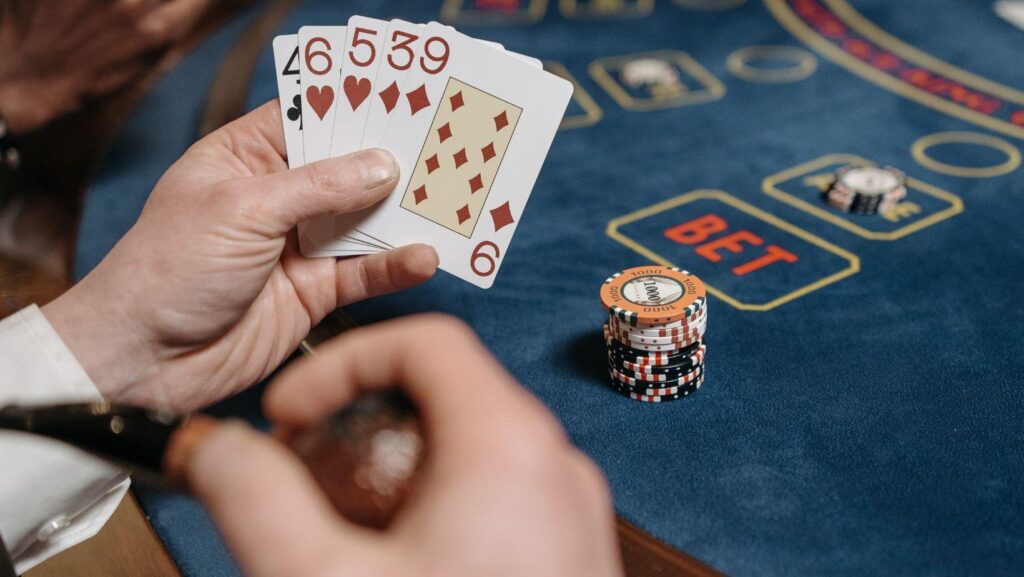
Baccarat has a reputation for being intimidating, mostly because of where it tends to be played: high-limit rooms, big minimums, a certain amount of ceremony. Strip that away, and it’s one of the simplest games on any casino floor, and one of the cheapest to play.
The numbers are unusually good
In standard eight-deck baccarat, the Banker bet carries a house edge of 1.06% and the Player bet 1.24%. Almost nothing else in a casino is that cheap. Banker wins 45.86% of hands, Player 44.62%, and the remaining 9.52% are ties.
That Banker figure already accounts for the 5% commission taken from winning Banker bets, which is why the payout is quoted as 19 to 20 rather than even money. The commission exists because the Banker hand acts last and therefore has more information when the third-card rules are applied. It’s a small tax on a structural advantage, and even after paying it, Banker remains the best bet on the table.
The whole bet menu comes down to three options, and the third is a trap. The Tie pays 8 to 1 and looks tempting for it, but the house edge on it is 14.36%, more than thirteen times the Banker bet. It’s the single most expensive way to play an otherwise cheap game.
So the practical strategy is short enough to fit in a sentence: bet Banker, accept the commission, and ignore the Tie.
“Commission-free” doesn’t mean cheaper
Plenty of tables advertise no commission on Banker, which sounds like a straight upgrade. It isn’t one label, though, and the two common versions land in opposite places.
EZ Baccarat pays Banker even money but pushes the bet when Banker wins with a three-card total of seven. That works out at 1.02%, fractionally better than standard.
Super 6, sometimes called Punto 2000, also drops the commission but pays only 1 to 2 on a winning Banker six. That comes to 1.46%, noticeably worse than the 1.06% you would have paid commission for.
Both variants bring their own side bets, and those are expensive: Dragon 7 runs at 7.61% and Panda 8 at 10.19%. Worth checking which version you’ve sat down at.
You cannot play it wrong
This is the part that matters more than the 1.06%, and it’s what separates baccarat from the other low-edge games.
Blackjack’s house edge of roughly half a percent is genuinely lower, but it’s conditional. You only get it by playing correct basic strategy on every hand, and most people don’t. Every misplayed sixteen against a ten widens the gap.
Baccarat has no such condition. The third-card rules are fixed, and the dealer executes them, so there are no decisions to make beyond choosing which of two bets to place. The 1.06% is what you get, not what you get if you play well. For a lot of players, the edge they actually face at a baccarat table is better than the one they face at a blackjack table.
Why that suits the way crypto players play
Fast deposits and fast rounds reward a game with no learning curve, and baccarat has almost none. There’s no chart to memorize, no decision tree, nothing to look up mid-hand. Sessions of Bitcoin baccarat tend to move quickly for the same reason the game has always been popular with high-stakes players: the whole thing is one bet, resolved in seconds, repeated.
One thing worth being clear about. A 1.06% edge is still an edge, and it applies to every hand independently. Hands are dealt from a shuffled shoe with no memory, so no pattern-tracking system, scorecard, or betting progression changes the maths. Baccarat is cheap, but it isn’t free.
Still, baccarat is a game with the lowest practical house edge most players will ever face and is simple enough that they can’t accidentally give any of it back.