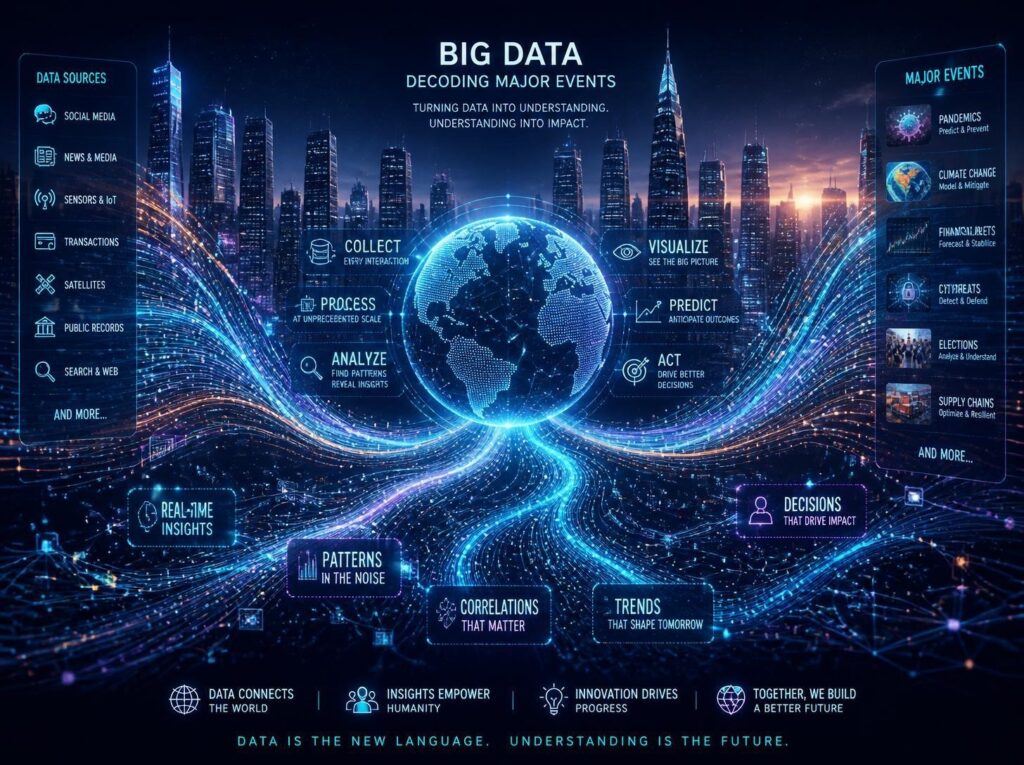
The landscape of major global events, from international sports tournaments to political elections, has been fundamentally transformed by the application of Big Data. Every second during a high-stakes match or a live event, millions of data points are generated, capturing everything from player biomechanics to fluctuating crowd sentiment. Analyzing these colossal datasets is no longer a luxury but a strict necessity for understanding trends, forecasting outcomes, and making empirical decisions in real time.
For sports enthusiasts and analytical platforms, this data-driven approach is the backbone of accurate forecasting. Leading operators in the sports and entertainment analytics sector, such as the renowned platform Betano Chile, leverage sophisticated algorithms to process historical statistics alongside real-time metrics. By relying on robust data pipelines, these platforms offer highly precise probability assessments, allowing users to understand the underlying dynamics of any major event far beyond what is visible on the surface.
The Mechanics of Big Data Analytics
Understanding the results of a major event requires moving past basic box scores and superficial observation. Big Data infrastructure collects, cleans, and synthesizes unstructured data from multiple sources simultaneously. This multidimensional analysis utilizes machine learning systems to identify hidden correlations and behavioral patterns that human observers typically miss, turning chaotic raw data into a structured timeline of probable events.
Core Data Elements Evaluated
To extract actionable intelligence from major events, data engineers and predictive models focus on specific, quantifiable metrics:
- Historical Performance Metrics: Win/loss records, head-to-head statistics, and long-term momentum trend lines spanning decades of previous encounters.
- Real-Time Biometric Data: Telemetry capturing heart rate, running speed, distance covered, and localized fatigue levels of athletes, gathered via wearable technology and optical tracking.
- Environmental Variables: Micro-climate weather conditions, temperature, humidity, and altitude differences, which systematically alter physical endurance and equipment physics.
- Sentiment Analysis: Natural Language Processing (NLP) applied to social media scraping to quantify public sentiment, crowd momentum shifts, and psychological pressure.
Turning Raw Data into Predictive Insights
The true power of Big Data lies in predictive analytics and algorithmic modeling applied to event outcomes. By feeding historical and live data into advanced neural networks, analysts can execute Monte Carlo simulations, generating millions of potential scenarios in fractions of a second. This statistical modeling identifies the most probable outcomes based on current weighted variables, adjusting dynamically as the event unfolds. The result is a total paradigm shift from reactive observation to proactive forecasting, creating a highly analytical environment where luck is quantified and volatility is mapped.
Frequently Asked Questions (FAQ)
How does Big Data improve prediction accuracy in sports and global events?
Big Data improves prediction accuracy by eliminating subjective human bias and relying entirely on empirical evidence. Rather than depending on intuition, data models aggregate millions of disparate variables—ranging from granular player statistics to external environmental factors—to calculate precise mathematical probabilities. As machine learning algorithms process more live and historical event data, they continuously refine and optimize their predictive parameters, resulting in consistently higher accuracy rates for forecasting complex, multi-variable outcomes.